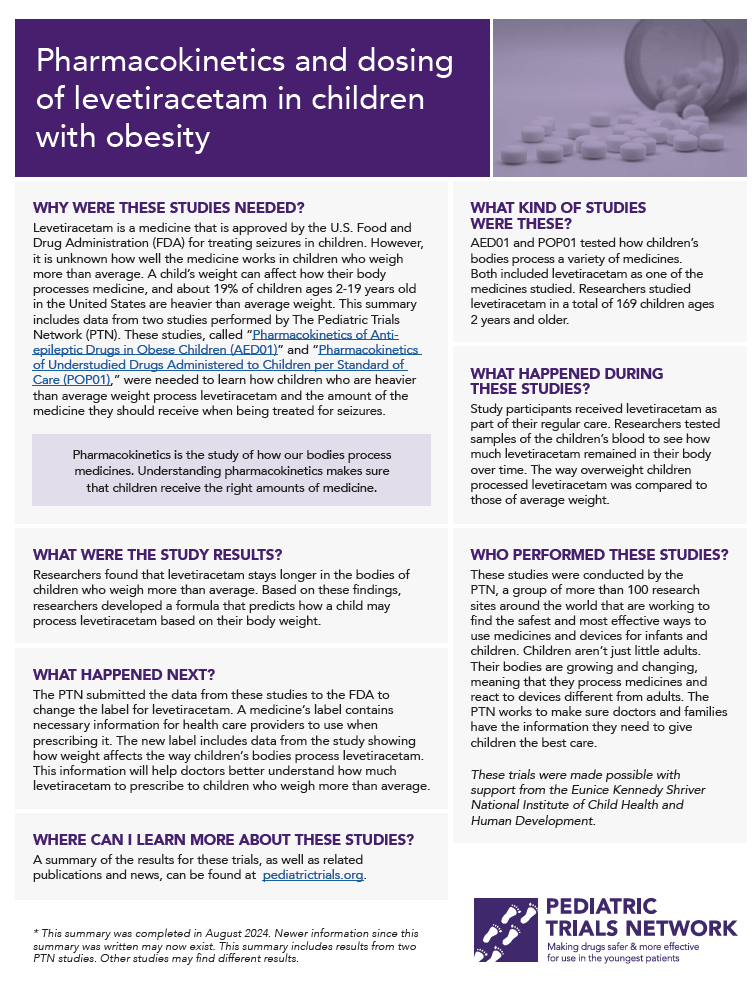



Thumbnail screenshot of PTN's levetiracetam results-at-a-glance summary.

Levetiracetam Results at-a-Glance

Read levetiracetam Results-at-a-Glance summary.

Levetiracetam is a medicine that is approved by the U.S. Food and Drug Administration (FDA) for treating seizures in children. However, it is unknown how well the medicine works in children who weigh more than average. These studies were needed to learn how children who are heavier than average weight process levetiracetam and the amount of the medicine they should receive when being treated for seizures.

Epidemiology and outcomes of bacterial meningitis in the neonatal intensive care unit

Journal of Perinatology July 2024

Access article on PubMed.

Aleem S, Benjamin DK Jr, Burns C, Duncan J, Melaku K, Norbekov A, Graham B, Mantena S, Ladipo T, Jung A, Zimmerman KO, Clark RH, Greenberg RG

This study examined pathogen distribution, antibiotic resistance patterns, and hospital outcomes of infants with bacterial meningitis in neonatal intensive care units (NICUs) in the US from 2013-2018.

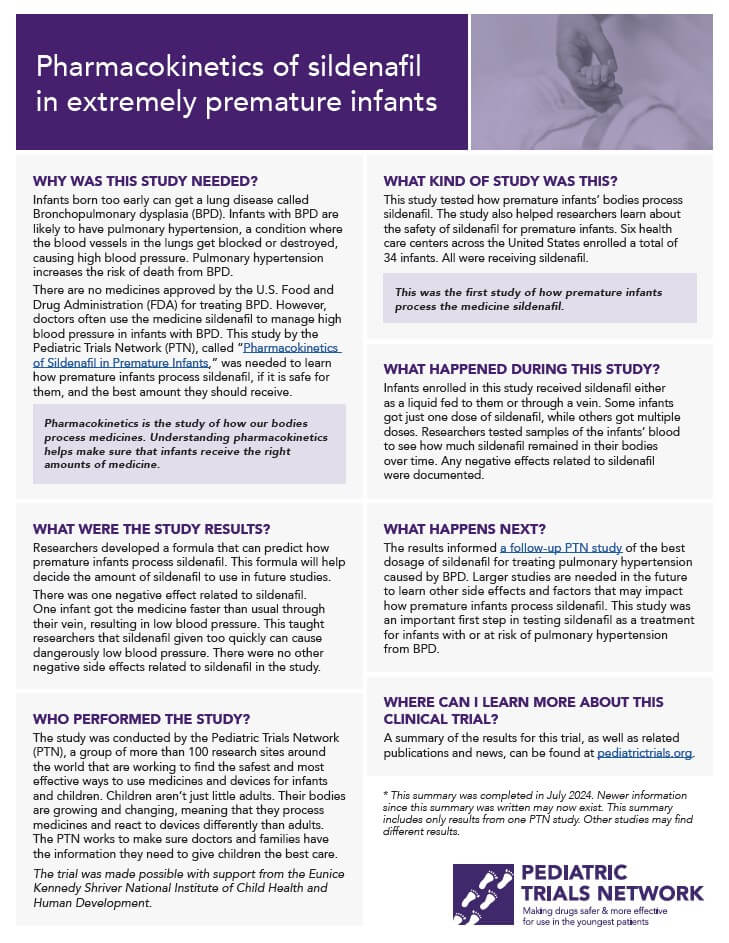
Thumbnail photo of sildenafil lay summary

Sildenafil Results-at-a-Glance

Read sildenafil Results-at-a-Glance summary.

Infants born too early can get a lung disease called Bronchopulmonary dysplasia (BPD). Infants with BPD are likely to have pulmonary hypertension, a condition where the blood vessels in the lungs get blocked or destroyed, causing high blood pressure. Pulmonary hypertension increases the risk of death from BPD. There are no medicines approved by the U.S. Food and Drug Administration (FDA) for treating BPD. However, doctors often use the medicine sildenafil to manage high blood pressure in infants with BPD.

Acyclovir Dosing Practices Across a Multicenter Cohort of Neonatal Intensive Care Units

The Pediatric Infectious Disease Journal June 2024

Foote HP, Thomassy H, Baquero L, Cayli M, Jacobs E, Paladugu A, Roy A, Heyward E, Clark RH, Hornik CP, Benjamin DK, Benjamin DK Jr, Greenberg RG

Acyclovir is the first-line therapy for neonatal herpes simplex virus infections. Therapy can mitigate morbidity and mortality but carries a risk for toxicity. This study aimed to compare acyclovir dosing in neonatal intensive care units to published recommendations based on population pharmacokinetic (PopPK) analysis.

Postdiscontinuation Antibiotic Exposure in Hospitalized Infants at Risk for Late-onset Sepsis in the Neonatal Intensive Care Unit

The Pediatric Infectious Disease Journal June 2024

Access article on PubMed.

Wade KC, Greenberg RG, Benjamin DK Jr., Chen L, Vo B, Ang BL, Boutzoukas A, Zimmerman KO, Clark RH, Cohen-Wolkowiez M, Le J on behalf of the Administrative Core Committee of the Best Pharmaceuticals for Children Act – Pediatric Trials Network

In the neonatal intensive care unit, infants are at risk for late-onset sepsis. When blood cultures are negative, antibiotic stewardship efforts encourage stopping antibiotics, yet the duration of therapeutic exposure after the last dose is unknown. Piperacillin and cefepime exposures remained therapeutic long after the expected 8- to 12-hour dosing interval. PDAE is an important consideration for antibiotic stewardship among hospitalized infants, particularly premature infants and those within 1 month postbirth.

Application of Physiologically Based Pharmacokinetic Modeling to Characterize the Effects of Age and Obesity on the Disposition of Levetiracetam in the Pediatric Population

Clinical Pharmacokinetics June 2024

Access article on PubMed.

Maglalang PD, Sinha J, Zimmerman K, McCann S, Edginton A, Hornik CP, Hornik CD, Muller WJ, Al-Uzri A, Meyer M, Chen L, Anand R, Perrin E, Gonzalez D., Best Pharmaceuticals for Children Act–Pediatric Trials Network Steering Committee

Levetiracetam is an antiseizure medication used for several seizure types in adults and children aged 1 month and older; however, due to a lack of data, pharmacokinetic (PK) variability of levetiracetam is not adequately characterized in certain populations, particularly neonates, children younger than 2 years of age, and children older than 2 years of age with obesity. PBPK modeling simulations revealed that the current US FDA-labeled pediatric dosing regimen listed in the prescribing information can produce the required exposure of levetiracetam in these target populations with dose adjustments for children with obesity aged 4 years to younger than 16 years.

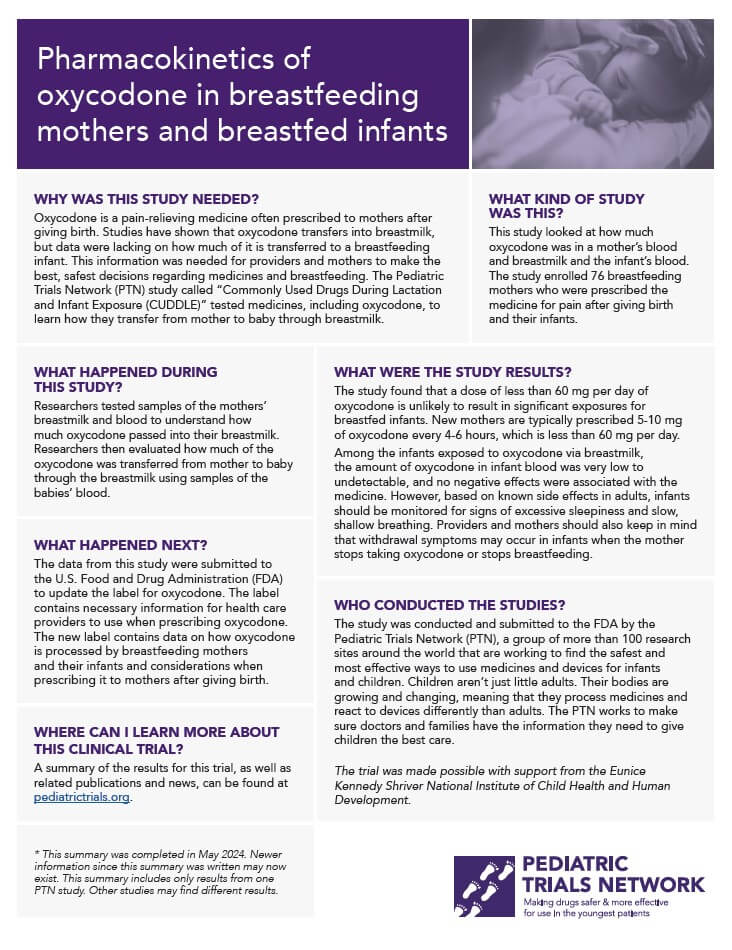
Thumbnail photo of oxycodone lay summary

Oxycodone Results-at-a-Glance

Read oxycodone Results-at-a-Glance summary.

Oxycodone is a pain-relieving medicine often prescribed to mothers after giving birth. Studies have shown that oxycodone transfers into breastmilk, but data were lacking on how much of it is transferred to a breastfeeding infant. This information was needed for providers and mothers to make the best, safest decisions regarding medicines and breastfeeding. The Pediatric Trials Network (PTN) study called “Commonly Used Drugs During Lactation and Infant Exposure (CUDDLE)” tested medicines, including oxycodone, to learn how they transfer from mother to baby through breastmilk.

Urinary Tract Infection Epidemiology in NICUs in the United States

American Journal of Perinatology May 2024

Access article on PubMed.

Kilpatrick R, Boutzoukas AE, Chan E, Girgis V, Kinduelo V, Kwabia SA, Yan J, Clark RH, Zimmerman KO, Greenberg RG

This study characterized the incidence, associated clinical factors, timing of infection, microbiology, and incidence of concordant blood culture of urinary tract infections (UTIs) in very low birth weight (VLBW <1,500g) infants. UTI is a common cause of infection in VLBW infants, especially among the smallest, most premature, male infants, and those with a longer duration of hospitalization. Neonatal clinicians should consider obtaining urine culture in the setting of late-onset sepsis evaluations in VLBW infants.

Opportunistic dried blood spot sampling validates and optimizes a pediatric population pharmacokinetic model of metronidazole

Antimicrobial Agents and Chemotherapy April 2024

Access article on PubMed.

Randell RL, Balevic SJ, Greenberg RG, Cohen-Wolkowiez M, Thompson EJ, Venkatachalam S, Smith MJ, Bendel C, Bliss JM, Chaaban H, Chhabra R, Dammann CEL, Downey LC, Hornik C, Hussain N, Laughon MM, Lavery A, Moya F, Saxonhouse M, Sokol GM, Trembath A, Weitk

Pharmacokinetic models rarely undergo external validation in vulnerable populations such as critically ill infants, thereby limiting the accuracy, efficacy, and safety of model-informed dosing in real-world settings. Here, we describe an opportunistic approach using dried blood spots (DBS) to evaluate a population pharmacokinetic model of metronidazole in critically ill preterm infants of gestational age (GA) ≤31 weeks from the Metronidazole Pharmacokinetics in Premature Infants study.

Fluconazole Results-at-a-Glance

Read fluconazole Results-at-a-Glance summary.

Fluconazole is an antifungal medicine often used to treat and prevent yeast infections in infants born prematurely and full-term. In infants, yeast can cause serious infections all throughout the body, including the skin, blood, heart, eyes, and brain. These yeast infections occur because infants have weaker immune systems than older children and adults, and the infections can lead to long-term health issues or even death. Despite the frequent use of fluconazole in infants, there was little data available on the pharmacokinetics, or how the medicine is processed in infants’ bodies.