



Access the Minor Assent Template.
Researchers can use this template to create their study’s minor assent form, for ages 10 and older. Follow the color-coded notes to add the needed information.
Access the Minor Assent Template.
Researchers can use this template to create their study’s minor assent form, for ages 10 and older. Follow the color-coded notes to add the needed information.
Access the ICF and Assent Instructions.
Researchers can use these instructions and template to create their study’s ICF and assent form. Follow the color-coded notes to add the needed information. The instructions also include definitions of terms used in ICFs and assent forms.
Access the PTN Parental Permission Form Template.
Researchers can use this template to create their study’s parental permission form. Follow the color-coded notes to add the needed information. This template also includes guidelines for making a parental permission form and definitions of terms.
Access the PTN Protocol Template.
Researchers can use this template to create their study protocol. Follow the color-coded notes to add the needed information. This template is adapted from the International Council for Harmonisation Guidance Document for Good Clinical Practice – E6(R2), Section 6.
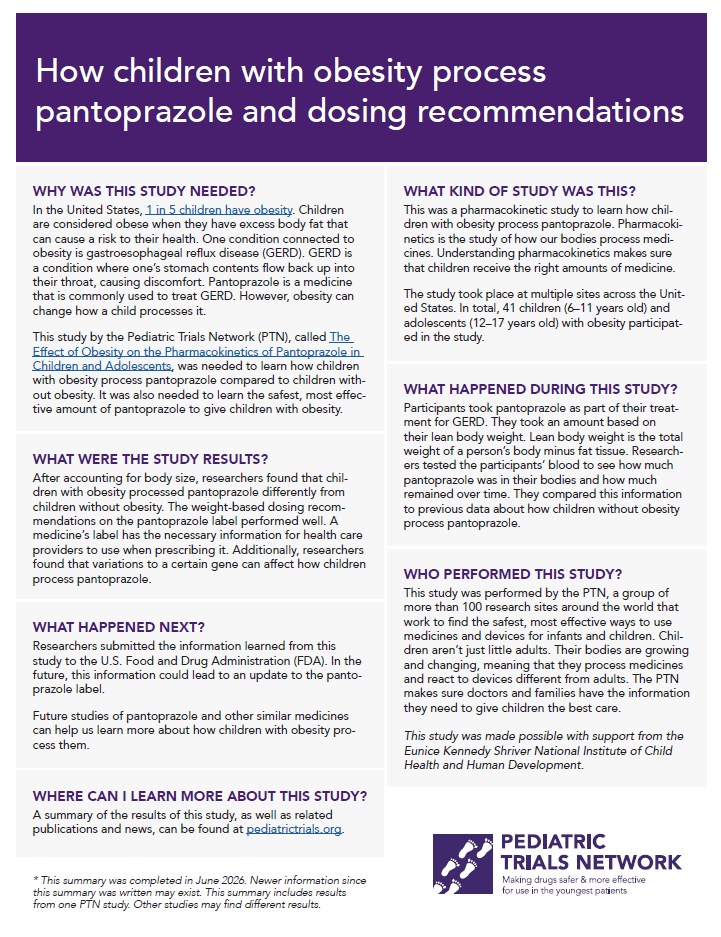
Read the pantoprazole Results-at-a-Glance summary.
Pantoprazole is a medicine that is commonly used to treat gastroesophageal reflux disease (GERD). A child’s obesity status can change how they process the medicine. This study learned how children with obesity process pantoprazole compared to children without obesity.
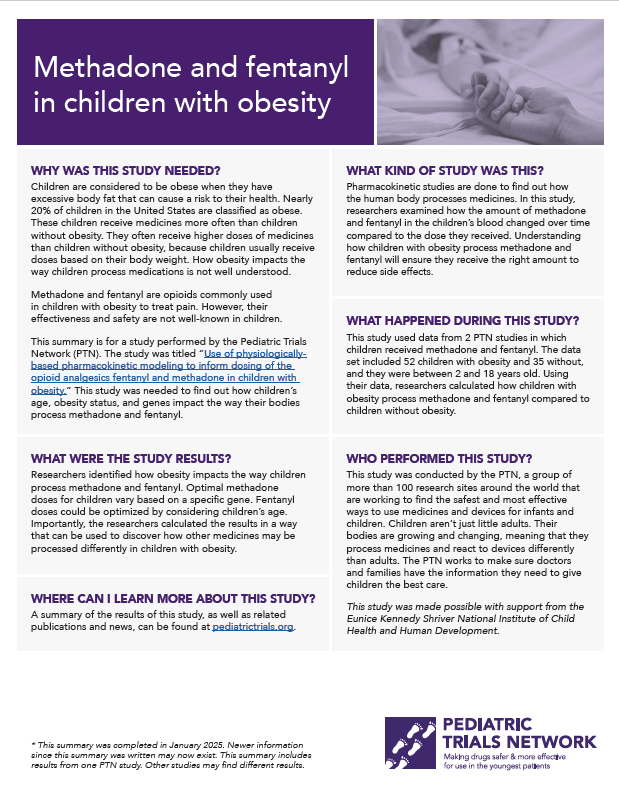
Read the methadone Results-at-a-Glance summary.
Nearly 20% of children in the United States are classified as obese. These children receive medicines more often than children without obesity, and the doses of medicines they receive are often based on body weight. How obesity impacts the way children process medications was not well understood. The “Use of Physiologically-based Pharmacokinetic Modeling to Inform Dosing of the Opioid Analgesics Fentanyl and Methadone in Children with Obesity” study was conducted to learn how children’s age, obesity status, and genes impact the way their bodies process methadone and fentanyl.
Watch the oxycodone Results-at-a-Glance video summary.
This video version of the oxycodone Results-at-a-Glance summary features iCAN member Adhiti.
Watch the diazepam Results-at-a-Glance summary video.
This video version of the diazepam Results-at-a-Glance summary features iCAN member Krisha.
Watch the rifampin Results-at-a-Glance summary video.
This video version of the rifampin Results-at-a-Glance summary features iCAN member Adhiti.
Watch the lisinopril Results-at-a-Glance video summary.
This video version of the lisinopril Results-at-a-Glance summary features iCAN member Luke.