



Watch the lisinopril Results-at-a-Glance video summary.
This video version of the lisinopril Results-at-a-Glance summary features iCAN member Luke.
Watch the lisinopril Results-at-a-Glance video summary.
This video version of the lisinopril Results-at-a-Glance summary features iCAN member Luke.
Watch the meropenem Results-at-a-Glance video summary.
This video version of the meropenem Results-at-a-Glance summary features iCAN member Arthur.
Watch the caffeine citrate Results-at-a-Glance video summary.
This video version of the caffeine citrate Results-at-a-Glance summary features iCAN member Meghan.
Watch the babyTAPE Results-at-a-Glance video summary.
This video version of the babyTAPE Results-at-a-Glance summary features iCAN member Katherine.
View the Publications Policy Version 6.0.
This PTN Publications Policy applies to information that represents PTN, is supported by PTN, or uses data provided by PTN. Examples of such information includes PTN Publications such as abstracts, manuscripts, slide decks, and texts of oral or other presentations. Additionally, this information can be PTN Public Presentations, such as text for social media or public-facing websites.
Therapeutic Innovation & Regulatory Science • February 2025
Abdel-Rahman S, Sund Z, Alderman C, Abella K, Kennel P, on behalf of the Best Pharmaceuticals for Children Act – Pediatric Trials Network Steering Committee.
Risks associated with clinical trial participation are a foremost consideration during protocol development whereas trial-associated burdens receive less focus despite their measurable impact on enrollment and retention. Of late, the U.S. Food and Drug Administration (FDA) has elevated discussions on barriers to research participation resulting from overly burdensome trials. Given the agency’s role in shaping clinical protocol design, this study examined the perceived burden associated with FDA-proposed study changes in the context of pediatric, off-patent, labeling studies.
Clinical Pharmacokinetics • February 2025
Boutzoukas AE, Balevic SJ, Hemmersbach-Miller M, Winokur PL, Gu K, Chan AW, Cohen-Wolkowiez M, Conrad T, An G, Kirkpatrick CMJ, Swamy GK, Walter EB, Schmader KE, Landersdorfer CB.
This study conducted an opportunistic pharmacokinetic study to evaluate the population pharmacokinetics of meropenem, an antimicrobial commonly used to treat Gram-negative infections in adults of different ages, including older adults, and determined optimal dosing regimens. Meropenem dosing should be based on renal function rather than age. For patients without renal impairment, extended infusion may increase the probability of target attainment.
Pharmacoepidemiology and Drug Safety • January 2025
Thakkar PV, Boutzoukas AE, Compton SN, Sivashankar O, Zimmerman KO, Benjamin DK Jr, Brookhart MA
Increases in adult stimulant prescribing pose a potential risk due to the higher prevalence of contraindicated conditions among this population. This study sought to identify patient, provider, and visit characteristics predictive of potentially inappropriate adult stimulant prescriptions. The proportion of potentially inappropriate adult stimulant prescriptions increased over time and with patient age. Visits to primary care providers were predictive of potentially inappropriate prescribing, and a history of substance abuse was predictive of new stimulant prescriptions; therefore, quality improvement interventions regarding safe stimulant prescribing practices may be warranted.
Cardiology in the Young • January 2025
Kumar KR, Ciociola EC, Skinner KR, Dixit GM, Alvarez S, Benjamin EK, Faulkner JC, Greenberg RG, Clark RH, Benjamin Jr DK, Hornik CP and Jan Hau Lee
New drugs to target different pathways in pulmonary hypertension have resulted in increased combination therapy, but details of this use in infants are not well described. This large multicenter database study describes the pharmacoepidemiology of combination pulmonary vasodilator therapy in critically ill infants. The study revealed an increased use of combination pulmonary vasodilator therapy, favouring inhaled nitric oxide and sildenafil, yet with considerable practice variation. Further research is needed to determine the optimal combination, sequence, dosing, and disease-specific indications for combination therapy.
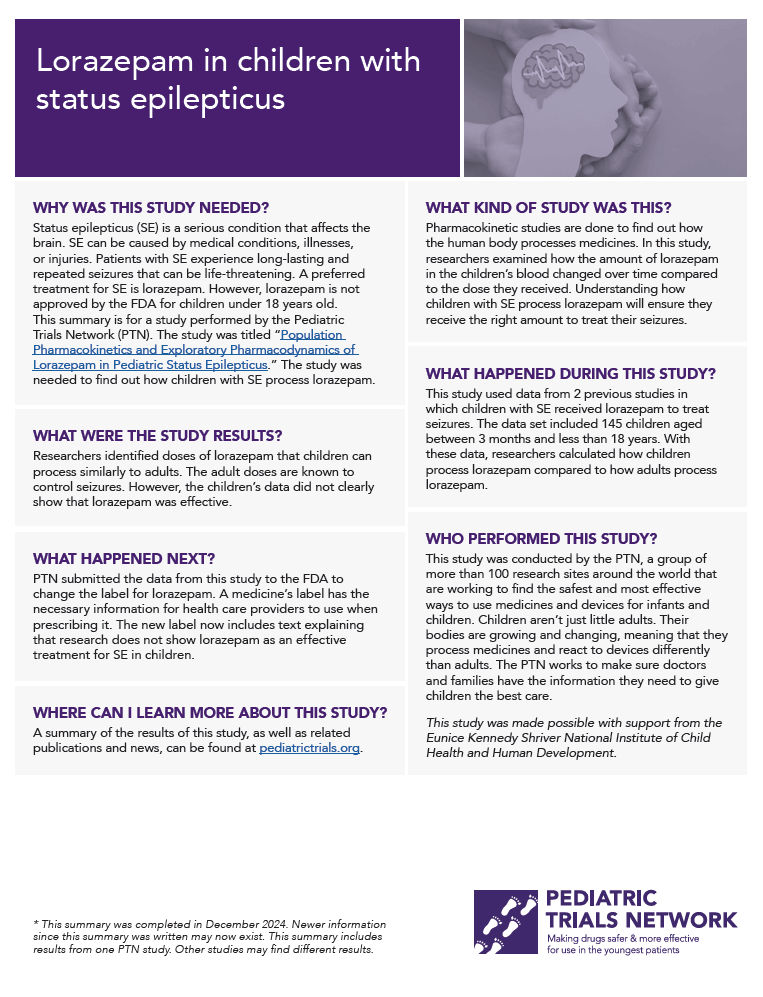
Read the lorazepam Results-at-a-Glance summary.
Status epilepticus (SE) is a serious condition that affects the brain. SE can be caused by medical conditions, illnesses, or injuries. A preferred treatment for SE is lorazepam. However, lorazepam is not approved by the FDA for children under 18 years old. This summary is for a study performed by the Pediatric Trials Network (PTN). The study was needed to find out how children with SE process lorazepam.