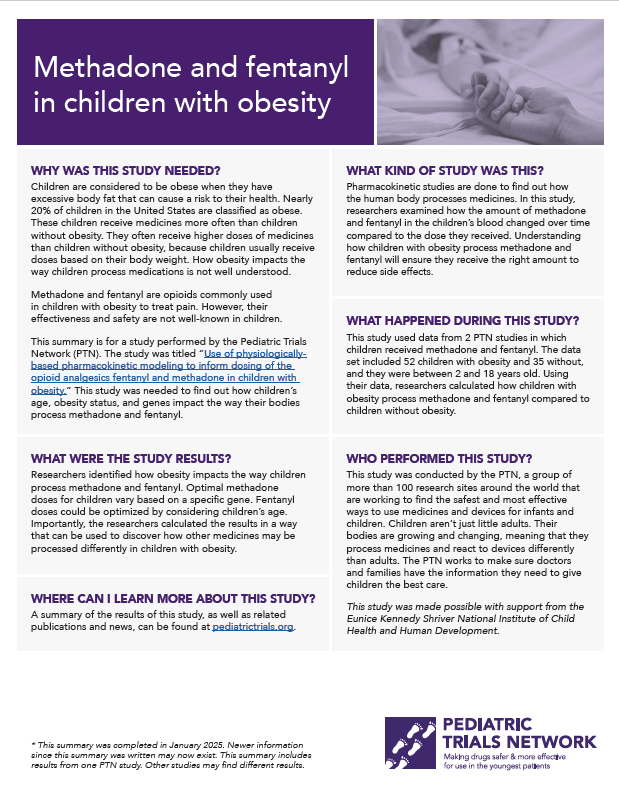



Thumbnail screenshot of methadone results-at-a-glance summary

Methadone Results-at-a-Glance

Read the methadone Results-at-a-Glance summary.

Nearly 20% of children in the United States are classified as obese. These children receive medicines more often than children without obesity, and the doses of medicines they receive are often based on body weight. How obesity impacts the way children process medications was not well understood. The “Use of Physiologically-based Pharmacokinetic Modeling to Inform Dosing of the Opioid Analgesics Fentanyl and Methadone in Children with Obesity” study was conducted to learn how children’s age, obesity status, and genes impact the way their bodies process methadone and fentanyl.

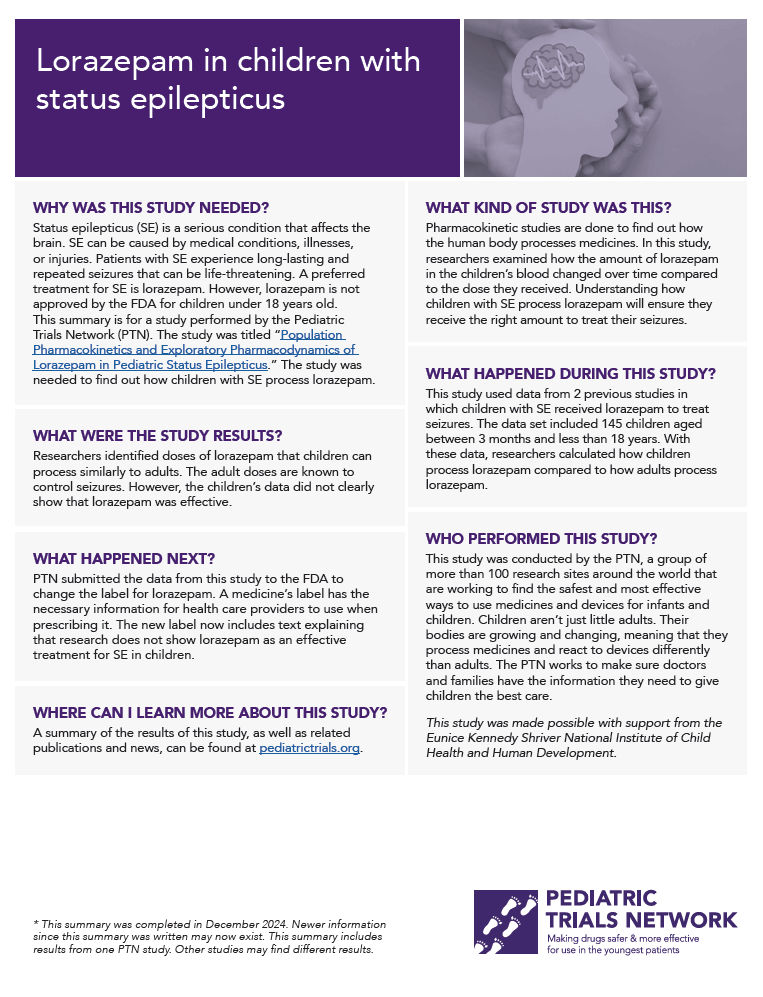
Thumbnail screenshot of lorazepam results-at-a-glance summary

Lorazepam Results-at-a-Glance

Read the lorazepam Results-at-a-Glance summary.

Status epilepticus (SE) is a serious condition that affects the brain. SE can be caused by medical conditions, illnesses, or injuries. A preferred treatment for SE is lorazepam. However, lorazepam is not approved by the FDA for children under 18 years old. This summary is for a study performed by the Pediatric Trials Network (PTN). The study was needed to find out how children with SE process lorazepam.

Thumbnail screenshot of Oxcarbazepine results-at-a-glance summary

Oxcarbazepine Results-at-a-Glance

Read the oxcarbazepine Results-at-a-Glance summary.

Oxcarbazepine is a medicine that is approved by the U.S. Food and Drug Administration (FDA) for treating seizures in adults and children older than two years. However, guidance for children who have obesity was lacking. This study was needed to learn how a child’s obesity status affects the way they process oxcarbazepine.